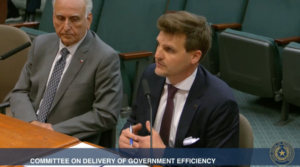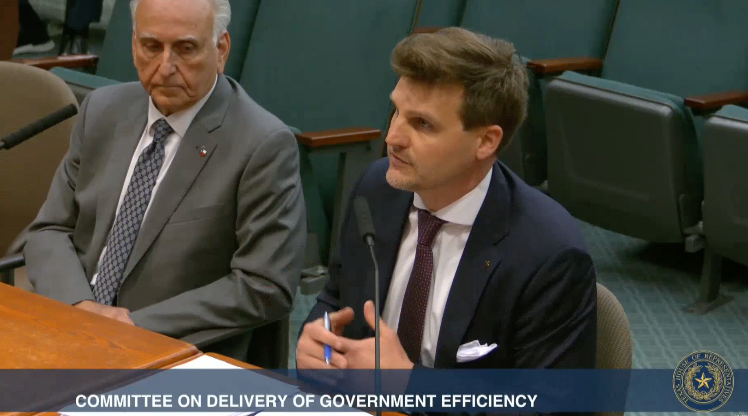
At a recent interim hearing of the Delivery of Government Efficiency (DOGE) Committee of the Texas House, the Director of the new Texas Regulatory Efficiency Office (TREO) discussed the work his office is doing to reduce the regulatory burden on Texans.
In his testimony to lawmakers, Jerome Greener noted that the work of the Texas Regulatory Efficiency Office was already projected to save Texans over $120 million.
Greener said that his office began meeting with the first eleven state agencies that would undergo regulatory efficiency reviews in March.
In those meetings with state agencies, he said, “we were able to discuss unnecessary and ineffective rules, the effect and cost to the state and regulated persons, and opportunities to repeal or amend rules to provide effective protection to the public with the least cost and inconvenience to regulated persons possible.”
According to data posted on the Texas Regulatory Efficiency Office’s website, the eleven agency reviews currently in progress have resulted in 437 estimated regulatory reductions and $123.2 million in estimated cost savings.
The review of the Texas Department of Transportation has resulted in the highest cost savings among the state agencies currently under review, with an estimated range of $36.2 million to $60.9 million.
Greener also discussed three guides published by the Texas Regulatory Efficiency Office.
The Regulatory Reduction Guide provides guidance to state agencies on identifying rules that are duplicative, obsolete, ineffective, or burdensome, as well as other regulatory reduction strategies. The Economic Analysis Manual provides guidance to agencies on conducting an economic impact analysis when proposing a new rule. The Rulemaking Guideexplains “the statutory requirements and establishes standards, recommendations, and best practices to ensure that every Texas state agency promulgates rules in a clear, concise, and consistent manner.”
The Texas Regulatory Efficiency Office was created by Senate Bill 14 – known as the Texas DOGE law – last year.
“We are putting at the forefront of legislation the shaping, formation, and recalibration of government in the State of Texas to make it more responsive and more efficient,” said Governor Abbott at a signing ceremony for the legislation. “We in Texas will now have our own DOGE, known as the Texas Regulatory Efficiency Office. This law will slash regulations, put stricter standards on new regulations that could be costly to businesses, and put a check on the growth of the administrative state. This will make government more efficient and less costly, ensuring that Texas operates at the speed of business. I am proud of everything the Texas Senate and House were able to achieve to get this bill to my desk, which is now law.”